10 Essential Blog Writing Tips to Boost Your Content

Most blog writing advice is recycled garbage. These 10 tips are different. They are honest, practical, and built for real beginners who want posts that people actually read.
You sit down to write. Your hands hover over the keyboard. The cursor blinks. Nothing comes. You feel like a fraud. You wonder if you should even keep blogging.
I have been there. Too many times. But here is the truth: you are not a bad writer. You just never learned the right blog writing tips – the ones that actually work for real people, not professional copywriters.
Most advice online is useless. “Write great content.” “Be authentic.” “Use storytelling.” Empty words. No actual steps.
This guide is different. I will give you 10 specific, actionable, beginner‑friendly tips that will transform your writing. Use them, and your next post will be better than your last 10 combined.
📌 Real story – Rasha wrote 30 posts nobody read
Rasha had a blog about study tips for students. She wrote 30 posts. Her traffic was stuck at 50 visitors per day. She felt like giving up. Then she stopped following generic advice. She focused on one thing: writing like she talks. Her next post got 500 shares on Pinterest. Her traffic doubled in a month. She was not a bad writer. She was just writing the wrong way.
⚠️ The #1 myth about blog writing:
“You need to be a great writer to succeed.” False. You need to be a clear, helpful, human writer. Great writing is a bonus. Clear writing is a necessity.
10 Essential Blog Writing Tips That Boost Your Content

Imagine one reader. Give them a name. Describe their problem. Write directly to that person. When you write for “everyone,” you connect with no one. When you write for Sarah, the busy mom who needs quick dinner ideas, your words become specific, helpful, and real.
Try this: Before you write, say out loud: “I am writing this for [Name], who struggles with [specific problem].” Keep that person in your mind.
Your headline is the most important sentence you will write. It decides if anyone clicks. Do not settle for the first one. Write 10 headlines. Pick the best. Then write 5 more.
Good headline framework: Number + Benefit + Specificity. Example: “10 Blog Writing Tips That Boost Your Content (Without Wasting Hours)”.
👉 Need help? How to Write Catchy Blog Titles
People decide whether to stay or leave within seconds. Your opening paragraph must grab them. Start with a relatable problem, a surprising fact, a bold statement, or a short story.
Avoid: “In this post, I will talk about…”
Do this instead: “You stare at a blank screen. Your cursor blinks. Nothing comes. I have been there.”
Long paragraphs scare readers. On a screen, anything longer than 3 sentences looks like a wall of text. Keep paragraphs to 1-3 sentences. Add line breaks between them.
Why it works: Short paragraphs create white space. White space makes your post feel easy to read. Easy to read means people actually read it.
Read your sentences out loud. If they sound unnatural, rewrite them. Use contractions (I’m, you’re, it’s). Use simple words. Use “you” a lot. Imagine you are explaining your topic to a friend over coffee.
Example: Instead of “It is advisable to utilize this technique,” write “Use this trick. It works.”
Most people skim before they read. Use clear subheadings (H2, H3) to break your post into sections. Each subheading should tell the reader what that section covers. Think of them as mini headlines inside your post.
Good subheading: “Why Short Paragraphs Work (Science Backs This)”
Bad subheading: “Paragraphs”
Abstract advice is forgettable. Specific examples stick. For every tip you give, add a real example. Show, do not just tell. This is what makes your content valuable – the specific application.
Example: Instead of saying “write short paragraphs,” show a before/after comparison.
SEO matters, but keyword stuffing is dead. Use your main keyword – in this case, blog writing tips – in your title, first paragraph, and 1-2 subheadings. That is it. Write for humans first. Google will understand.
👉 Full guide: How to Do Keyword Research for Beginners
Do not leave your reader hanging. Tell them what to do next. Ask a question to start a conversation. Invite them to comment, share, or try your advice. A simple “What tip will you try first?” can double your comments.
Good CTAs: “What is your biggest writing struggle? Let me know in the comments.” “Try tip #3 today and come back to tell me how it went.”
After you finish writing, take a break. Come back with fresh eyes. Cut unnecessary words. Fix confusing sentences. Remove fluff. But here is the most important part: do not let perfect be the enemy of done. Publish anyway.
Remember: Your first post will not be perfect. Your 50th will be better. Your 100th might be great. But you will never get to 100 if you do not publish the first.
💡 Pro Tip: Read your post out loud before publishing. Every time you stumble or pause, rewrite that sentence. Your ear knows good writing better than your brain.
The 30-Minute Blog Writing Workflow

📌 Minutes 0-5: Brainstorm 10 headlines. Pick the best.
📌 Minutes 5-10: Write a quick outline (subheadings only).
📌 Minutes 10-25: Write the first draft. Do not edit. Do not stop. Just write.
📌 Minutes 25-30: Edit for clarity and typos. Add a CTA. Hit publish.
That is it. Stop overthinking. Start publishing.
Common Blog Writing Mistakes That Kill Your Content
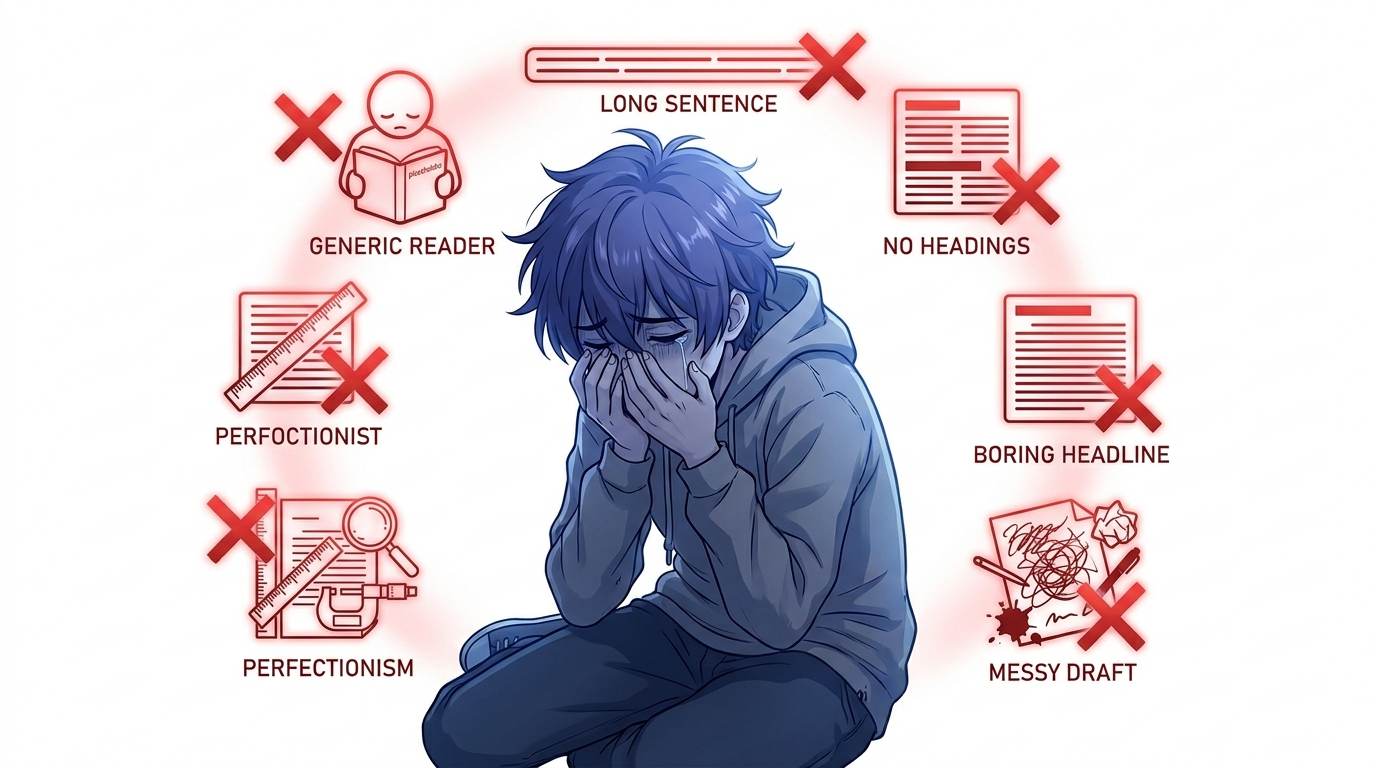
- ❌ Writing without a clear reader in mind. Your post feels generic and forgettable.
- ❌ Using long, complex sentences. Readers get lost. Simpler is better.
- ❌ No subheadings. Walls of text scare people away.
- ❌ Boring, vague headlines. Nobody clicks. Your great content stays hidden.
- ❌ Not editing. First drafts are messy. Always edit at least once.
- ❌ Waiting for perfection. Perfectionism is procrastination in disguise.
FAQ – Blog Writing Tips for Beginners
- How long should my blog post be?
For beginners, 800‑1,500 words is plenty. Focus on being helpful, not on hitting a word count. - How often should I publish?
Once per week is ideal for beginners. Consistency beats frequency. - Should I use AI to write my posts?
Use AI for outlines, ideas, and grammar checks. Write the final version yourself. Your voice is your advantage. - How do I know if my writing is good enough?
If it is clear, helpful, and honest, it is good enough. Publish and improve as you go.
Final Thoughts: You Are Already a Blogger – Now Write Like One
You do not need a degree in English. You do not need to be a professional writer. You just need to care about your reader and show up consistently.
Rasha wrote 30 posts that nobody read. Then she changed one thing – she started writing like she talks. Her traffic doubled. You can do the same.
Pick one tip from this list. Apply it to your next post. Then pick another. Keep improving. Keep publishing.
Your words matter. Someone out there needs exactly what you have to say. Do not let them wait forever.
You have got this. ✍️